The Modern Worker’s BATNA: Why "Shadow AI" Is Winning
Inside every organization, there are two parallel realities regarding AI adoption.
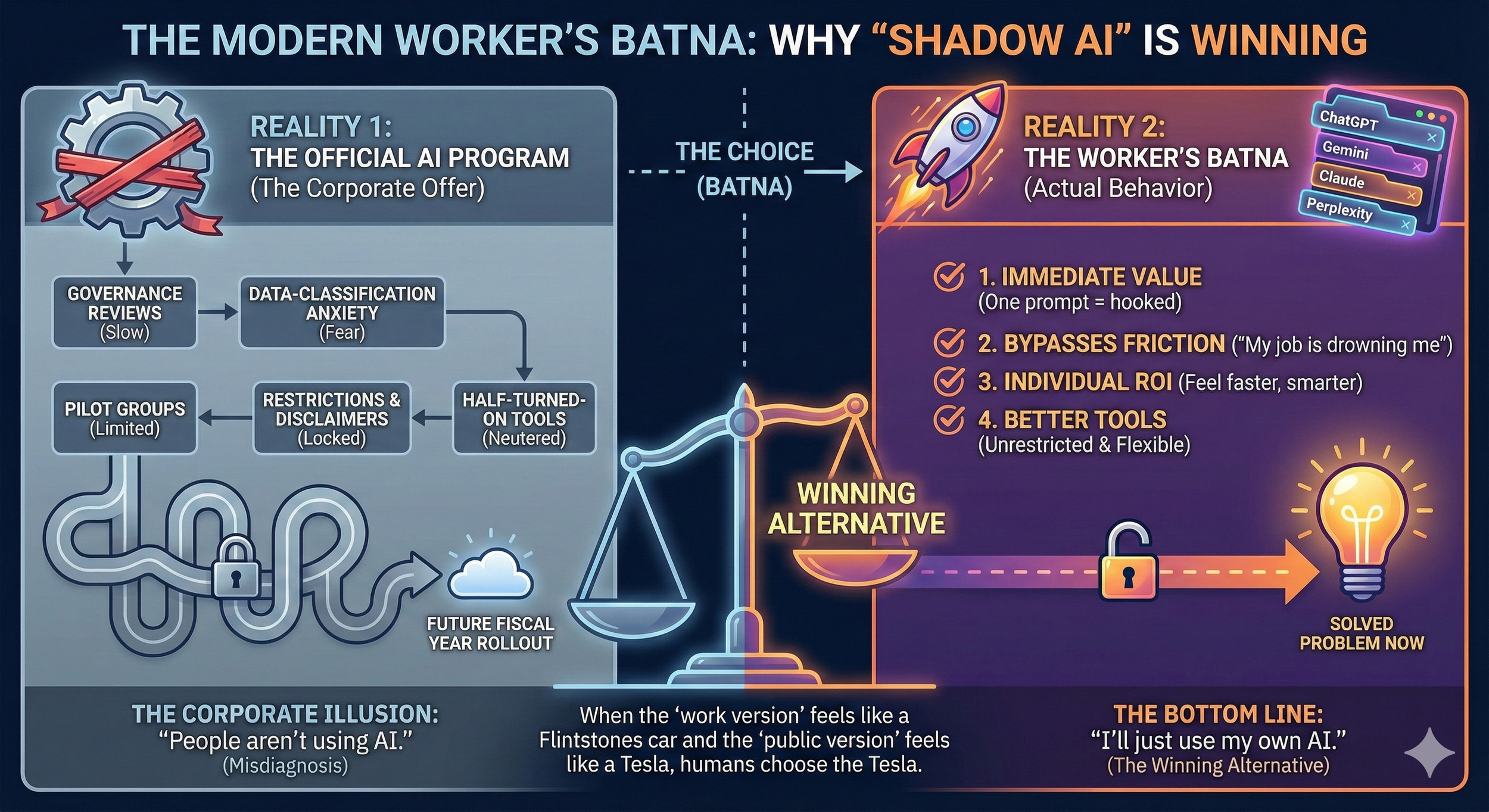
Reality 1: The Official AI Program This is what leadership sees. It consists of governance reviews, data classification anxiety, and pilot groups. It is defined by restrictions, disclaimers, and "approved use cases." It features tools that are half turned on ("Copilot, but not in this app, and only for 50 people") and a rollout timeline that stretches comfortably into the next fiscal year.
Reality 2: The Actual Behavior This is what humans are actually doing to get work done. They open ChatGPT, Gemini, Claude, or Perplexity. They solve the problem immediately. They do not file a ticket, ask for permission, or wait for the rollout. They do not advertise it. They aren't being malicious. They are just trying not to drown.
The Real Definition of BATNA In negotiation theory, BATNA stands for the Best Alternative to a Negotiated Agreement. It is your walk-away point. If the deal on the table is worse than your BATNA, you walk away.
We have hit the real BATNA for the modern knowledge worker. The deal the enterprise is offering is: "Wait 6 months for a compliant, restricted tool." The worker’s BATNA is: "I’ll just use my own AI right now."
Why the BATNA is Winning This is the AI version of what happened with Dropbox (2007–2012) and Slack (2014–2018), but 10x more potent because generative AI assists with thinking, not just storage or chat.
The individual's alternative is winning for four reasons:
The value is immediate People do not need a 3-month enablement plan to see productivity gains. One strong prompt, one good ideation session, one solved problem, and they are hooked.
It bypasses organizational friction Workers are not rebellious; they are exhausted. Shadow AI is a survival mechanism. It says: "My job is overwhelming me. I am not waiting six months for help."
The ROI shows up at the individual level Enterprises track system ROI. Individuals track felt improvement. They feel faster drafting, cleaner thinking, better organization, and more confident communication. Those lines rarely converge without intentional OCM intervention.
The consumer tools are simply better Workers know that ChatGPT doesn't block half the features, and Perplexity doesn't panic when you paste in an email thread. When the "work version" feels like a Flintstones car and the "public version" feels like a Tesla, humans will choose the Tesla.
The Corporate Illusion This is why leadership teams misdiagnose low usage numbers on their official platforms. They think the problem is a lack of interest.
The real problem is that the official tool is not competitive with the worker’s BATNA. You cannot beat "I'll just open ChatGPT" with a locked down, neutered version of Copilot or an AI policy document written by Legal in 2019.
The Bottom Line We are entering a world where individuals drive AI adoption bottom up, not companies top down. AI "competence" is becoming part of personal productivity, not just employer capability.
If you are wondering why your enterprise AI adoption feels sluggish while consumer AI numbers explode, stop looking at your training materials. Look at your competition. Your competition is not another company. Your competition is the tool your employees are already using.